When Sellers Have Second Thoughts

Practical risk-management guidance for manufactured homes, park models, tie-downs, and accessory structures in Central Arizona resale transactions.
By Dennis Riccio, President, Central Arizona Association of REALTORS®
Co-authored by Steve Cantrill, Treasurer, Central Arizona Association of REALTORS®

Manufactured homes, mobile homes, park models, RV-type units, carports, awnings, decks, and accessory structures are common in Central Arizona real estate transactions. They are also common sources of confusion.
These issues can affect inspections, appraisals, financing, insurance, park approval, floodplain compliance, permitting, disclosures, and closing timelines. A missing tie-down, undocumented carport, unclear title status, or mistaken assumption about whether a unit is a manufactured home, mobile home, park model, or recreational vehicle can quickly become a transaction problem.
The goal of this article is not to turn REALTORS® into engineers, installers, code officials, lenders, insurance underwriters, or attorneys. The goal is to help members recognize when more information is needed, ask better questions, document uncertainty, make appropriate disclosures, and direct clients to qualified professionals.
Key Takeaways for REALTORS®
Important Note: This Is Not Legal or Code Advice
This article is for general risk-management education only. It is not legal, engineering, code, lender, insurance, or installation advice. Manufactured-home, park-model, RV, tie-down, anchoring, carport, and accessory-structure requirements can be fact-specific and may vary by unit type, location, title status, installation history, floodplain status, park/community rules, lender requirements, insurance requirements, and local permitting history. REALTORS® should avoid making definitive compliance statements unless supported by reliable documentation or confirmed by the appropriate authority or professional.
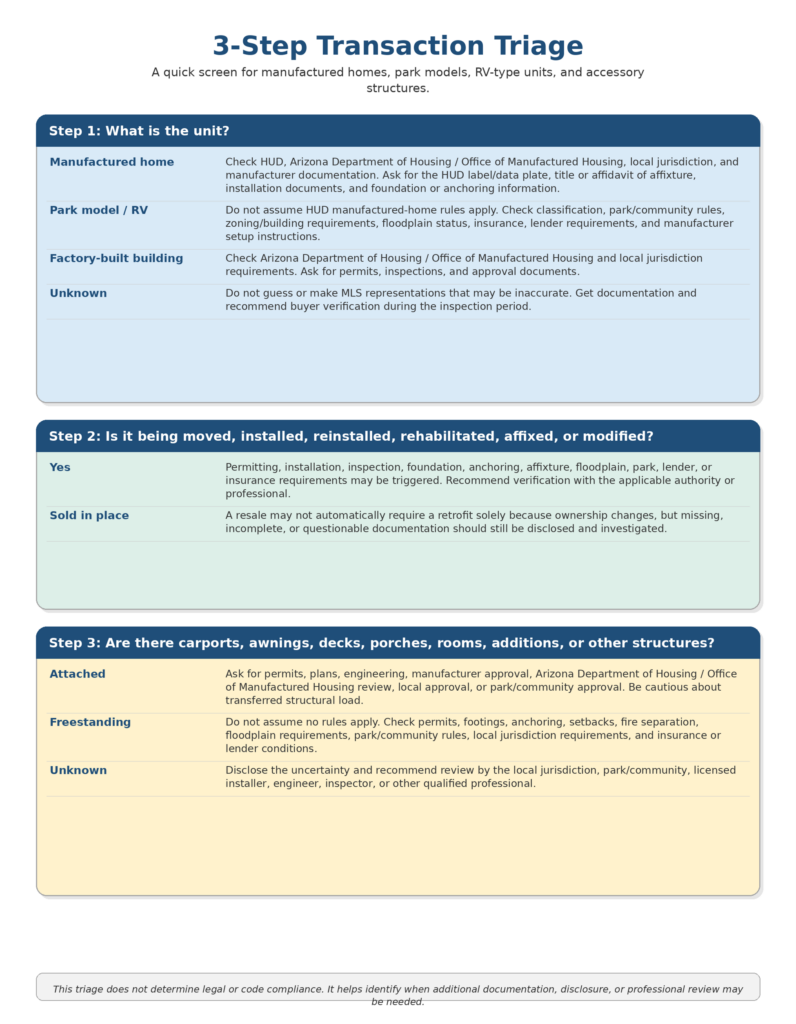
As the triage table notes, classification comes first. A HUD-code manufactured home is not the same as a pre-HUD mobile home. A park model is not necessarily regulated the same way as a manufactured home. A recreational vehicle is not necessarily treated the same way as an affixed manufactured home. A factory-built building is another category altogether.
Arizona transactions may involve several different classifications, including:
Unaffixed units treated as personal property.
For REALTORS®, the practical point is simple: do not guess. Ask for documents. Look for a HUD label or data plate when applicable. Ask whether there is an affidavit of affixture. Determine whether the unit is on owned land, leased land, in a manufactured-home community, in a mobile-home park, in an RV park, or on rural property.
The classification matters because different rules may apply.
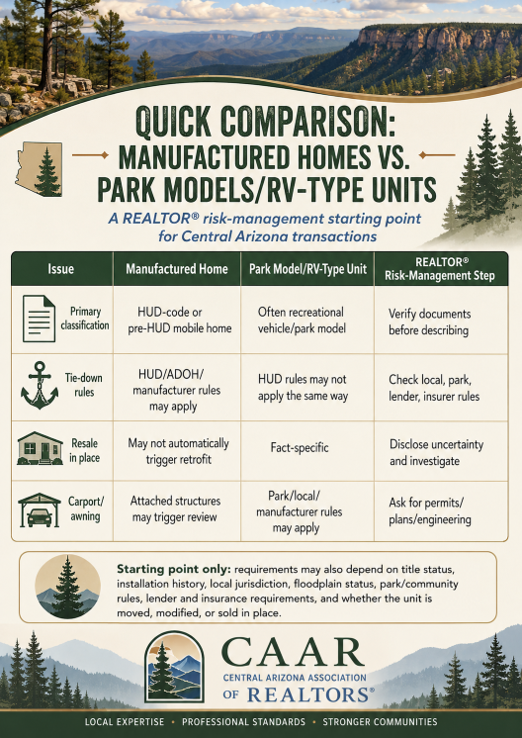
Because similar-looking units may be regulated differently, the following comparison can help REALTORS® identify when additional documentation or professional review may be needed.
For HUD-code manufactured homes, anchoring and support are important installation issues. Federal manufactured-home installation standards generally require the home, after blocking and leveling, to be secured against wind through anchor assemblies or an approved alternative foundation system. The anchoring or foundation system must be capable of meeting the design loads applicable to the home.
But there is no single universal answer for the number, spacing, or type of tie-downs.
The correct anchoring system may depend on the manufacturer’s installation manual, the HUD data plate, wind zone, roof load zone, soil classification, anchor rating, foundation design, and whether an engineer-approved alternative system is used.
REALTORS® should avoid statements such as “it is properly tied down,” “it is grandfathered,” “it meets code,” or “it does not need anchors” unless the statement is supported by reliable documentation or confirmed by the appropriate professional or authority.
A common resale question is whether an existing manufactured home that lacks visible or documented tie-downs must automatically be retrofitted simply because it is being sold.
The answer is fact-dependent. An in-place resale may not, by itself, automatically create a statewide tie-down retrofit requirement simply because ownership changes. However, the absence of visible or documented anchoring can still be a material transaction issue.
Anchoring, foundation, or tie-down questions may become important when the home is:
In practice, the issue is not only “Does Arizona automatically require a retrofit at resale?” The better question is “Will this transaction require proof of compliant installation, anchoring, foundation, affixture, permitting, park approval, lender approval, or insurance approval?”
If tie-downs are missing, undocumented, inaccessible, visibly questionable, or contradicted by seller statements, REALTORS® should treat the issue as something to disclose, document, and investigate during the inspection period.
Park models and RV-type units should not automatically be analyzed as HUD-code manufactured homes.
Under Arizona law, a park trailer or park model may be classified as a recreational vehicle if it meets statutory criteria, including being built on a single chassis, mounted on wheels or originally mounted on wheels, designed for utility connections, and within the size range stated by statute.
A true park model or RV may not be subject to HUD manufactured-home tie-down rules in the same way as a HUD-code manufactured home. But that does not mean there are no rules.
Park models and RV-type units may still be affected by:
For Central Arizona transactions, members should be especially careful when a park model looks like a small manufactured home, has additions, has skirting, has utility connections, has a carport, or has been used long-term as a residence. Those facts may raise questions about classification, permitting, occupancy, lender requirements, insurance, or park approval.
Carports and awnings are often where transaction problems appear.
A carport, awning, deck, porch, ramada, garage, patio, or similar structure may raise issues if it is attached to or structurally supported by a manufactured home, mobile home, factory-built building, park model, or RV-type unit.
The research did not identify a rule requiring a carport to be anchored to the manufactured home itself. In many cases, the safer question is whether the carport is independently supported and anchored, or whether it is attached in a way that transfers load to the home.
If a carport or awning is attached to the home, members should ask whether there are approved plans, permits, engineering, manufacturer approval, Arizona Department of Housing review, or local approval.
If the carport is freestanding, members should still ask whether it complies with local building permits, zoning, setbacks, fire separation, floodplain rules, park rules, and manufacturer installation requirements.
A freestanding carport may avoid some concerns associated with imposing structural loads on the home, but it is not automatically exempt from all rules. Detached or freestanding structures may still require permits, engineering, setbacks, inspections, or park approval depending on the property and location.
Central Arizona REALTORS® should not assume that generic manufactured-home guidance answers every transaction question.
For unincorporated Gila County, county materials indicate that Gila County works with the Arizona Department of Housing Manufactured Housing Division regarding manufactured-home and factory-built-building permitting and inspections. County materials also indicate that manufactured-home permits address setup inspections and that separate permits may be required for additional structures.
Gila County materials further indicate that only HUD-approved manufactured homes are permitted in unincorporated areas of the county.
For the Town of Payson, members should check directly with the Town’s building, zoning, development services, and floodplain officials when a transaction involves a manufactured home, park model, RV-type unit, carport, awning, deck, porch, detached structure, or floodplain concern.
In both Gila County and Payson, local rules, permit history, floodplain status, property location, and park/community rules may matter. Publicly available information may not answer every property-specific question. When the answer is unclear, verification should come from the local jurisdiction, Arizona Department of Housing / Office of Manufactured Housing, the park/community, a licensed installer, a registered engineer, the lender, the insurer, or legal counsel.
Document. Disclose. Verify.
Do not guess when classification, anchoring, permitting, or accessory structures are unclear.
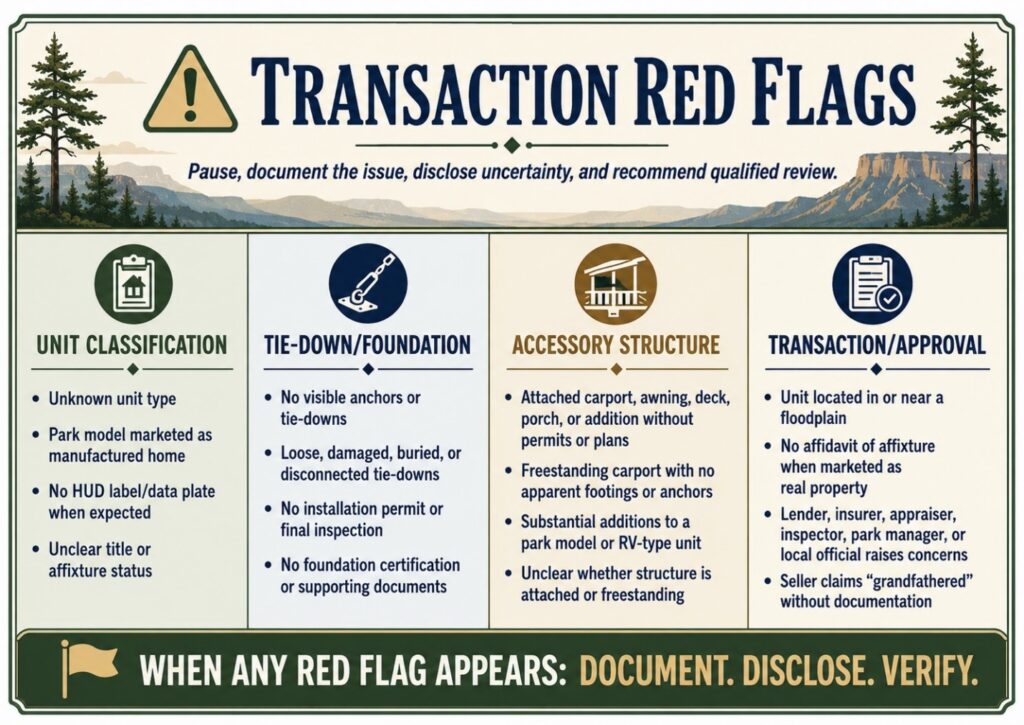
Members should pause and recommend further investigation when they encounter any of the following:
Listing agents should ask sellers direct questions about classification, title status, affixture, tie-downs, foundation, permits, floodplain status, and additions.
If the seller does not know, say that. Do not guess.
If tie-downs are missing or undocumented, if a carport appears to be attached without known permits, or if a park model is being marketed in a way that could confuse buyers, disclose the uncertainty and recommend buyer investigation.
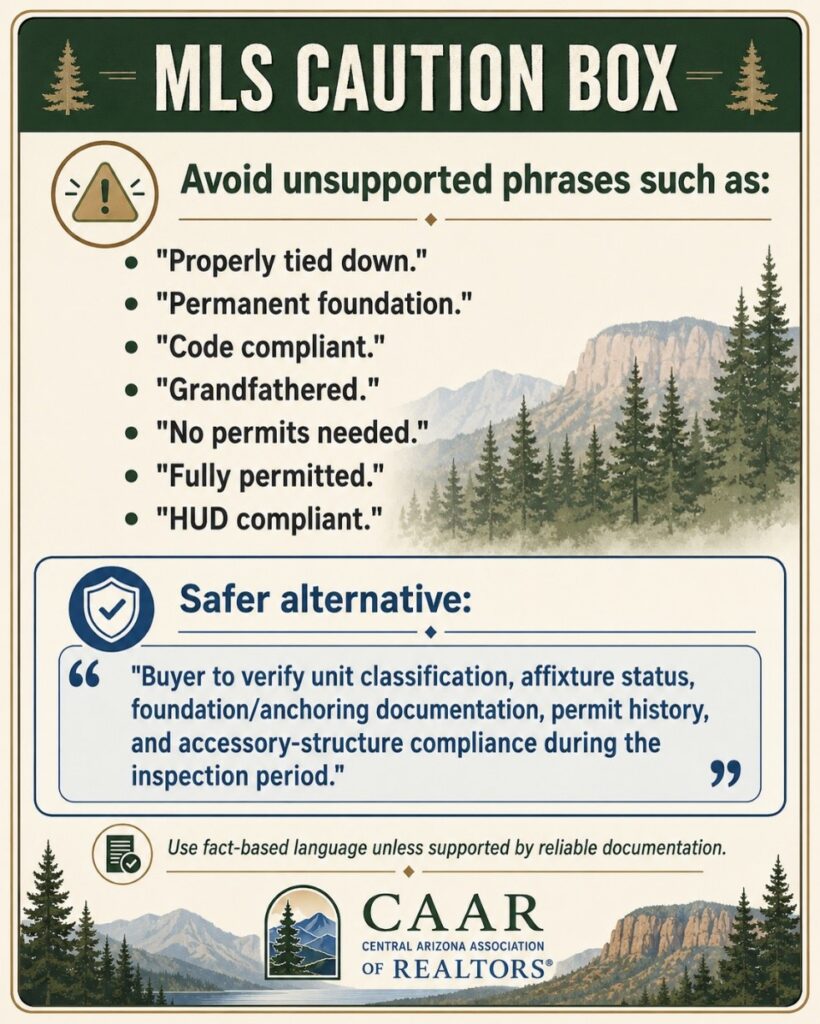
MLS remarks should be fact-based and should avoid unsupported technical conclusions.
Buyer agents should encourage buyers to investigate these issues early in the inspection period.
A general home inspection may not be enough. Depending on the property, buyers may need information from:
A REALTOR® might say:
“Manufactured homes, mobile homes, park models, RV-type units, tie-downs, foundations, carports, awnings, and additions can be regulated differently depending on the unit, location, title status, park rules, floodplain status, financing, insurance, and whether the unit has been moved, reinstalled, modified, or affixed. I cannot determine code compliance, engineering compliance, or legal classification for you, but we should request the available documents and have the appropriate professionals review the issue during the inspection period.”
Members may consider adapting language similar to the following:
“Seller and broker make no representation that the manufactured home, mobile home, park model, RV-type unit, foundation, anchoring, tie-down system, carport, awning, deck, porch, or other accessory structure complies with current legal, engineering, installation, park, lender, insurer, or local-code requirements. Buyer is advised to obtain independent review by the applicable jurisdiction, park/community, lender, insurer, licensed installer, engineer, and/or legal counsel during the inspection period.”
Members may also consider:
“Installation permits, final inspections, title/affixture records, foundation documents, and permits or plans for accessory structures may be incomplete or unavailable. Buyer should independently verify unit classification, title status, affixture status, floodplain status, permit history, and any lender or insurance requirements.”
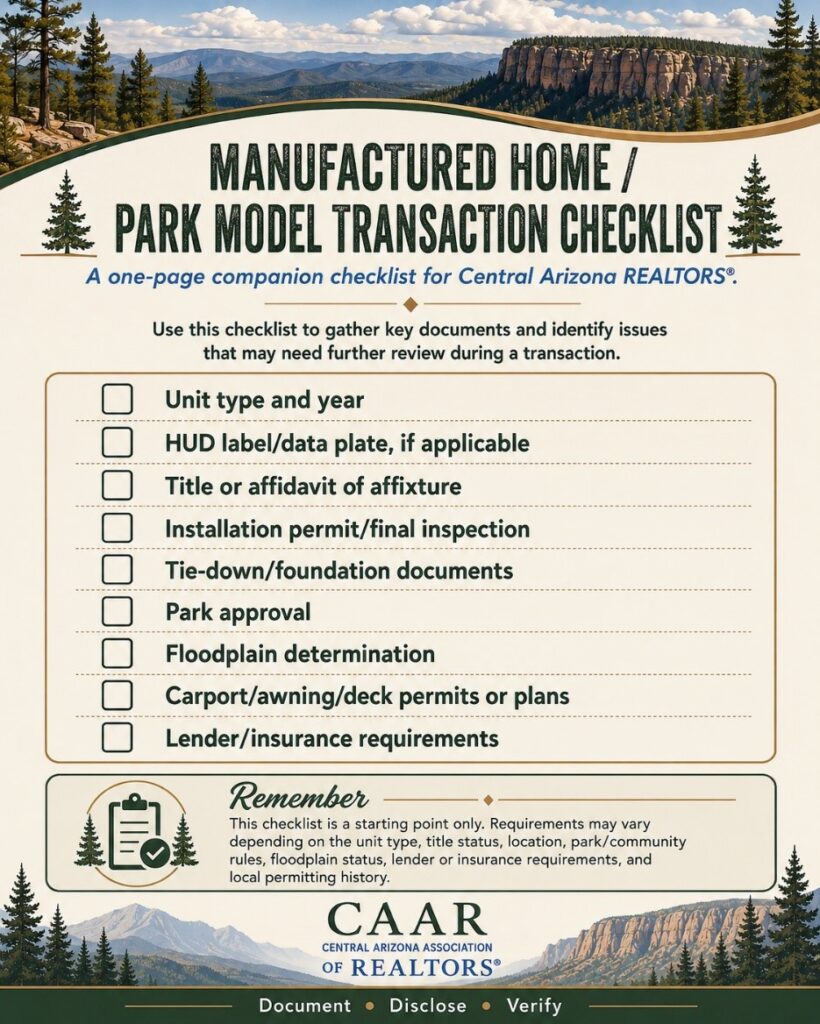
To help members apply the guidance above in actual transactions, the following one-page checklist can be printed or saved for file review.
Manufactured homes, mobile homes, park models, RV-type units, and accessory structures are an important part of the Central Arizona housing market. They also require careful classification and documentation.
The safest professional habit is to identify the unit type early, disclose known facts and uncertainty, gather available documents, avoid giving technical code opinions, and direct clients to qualified professionals when foundation, anchoring, floodplain, park approval, financing, insurance, or accessory-structure issues are present.
When in doubt, REALTORS® should not guess. They should document the uncertainty, recommend appropriate investigation, and encourage the parties to obtain guidance from the applicable local jurisdiction, Arizona Department of Housing / Office of Manufactured Housing, the park or community, the lender, the insurer, a licensed installer, a registered engineer, and legal counsel when appropriate.
This article is provided for general risk-management education only. It is not legal advice, engineering advice, code advice, lender advice, insurance advice, installation advice, or a determination of whether any specific property complies with applicable law, code, lender, insurance, or park/community requirements.
This article is provided by the Central Arizona Association of REALTORS® for general educational and risk-management purposes only. It is not legal advice, engineering advice, code advice, installation advice, lender advice, insurance advice, or a determination that any specific property, unit, foundation, anchoring system, tie-down system, carport, awning, deck, porch, accessory structure, title status, affixture status, or permit history complies with applicable law, code, lender, insurance, park/community, or local jurisdiction requirements.
Requirements may vary depending on the facts, including the type of unit, date of manufacture, title status, affixture status, installation history, location, zoning, floodplain status, park/community rules, lender requirements, insurance requirements, manufacturer instructions, and whether the unit is being sold in place, moved, reinstalled, rehabilitated, affixed, modified, or improved.
Members should not make legal, engineering, code, installation, lender, insurance, or compliance representations outside their expertise. When questions arise, members should recommend that the parties consult the appropriate local jurisdiction, Arizona Department of Housing / Office of Manufactured Housing, park/community, lender, insurer, licensed installer, registered engineer, home inspector, and/or legal counsel.
This article is based on federal HUD manufactured housing standards, Arizona statutes and administrative rules, Arizona Department of Housing / Office of Manufactured Housing materials, Arizona Department of Revenue manufactured housing guidance, and local Gila County materials. Members should also check Town of Payson requirements, local floodplain rules, park/community rules, lender requirements, insurance requirements, manufacturer instructions, and qualified professional guidance for the specific property.
Key references include HUD 24 C.F.R. Parts 3280 and 3285, Arizona Revised Statutes, Arizona Administrative Code Title 4, Chapter 34, Arizona Department of Housing manufactured housing guidance, the Arizona Department of Revenue Manufactured Housing Manual, and Gila County Community Development / Building Safety manufactured home permit materials.
This source list is provided for general educational reference only. Requirements may change and may vary depending on the unit, location, title status, installation history, floodplain status, park/community rules, financing, insurance, and local permitting history.
Interested in what CAAR does and how you can get involved? Contact us below to talk to our team.