When Sellers Have Second Thoughts

By Dennis R. Riccio, President, Central Arizona Association of Realtors

A recent dispute in the Chicago area involving Zillow, Midwest Real Estate Data, and Compass has drawn national attention across the real estate industry. The legal issues in that case will be decided elsewhere, and CAAR is not taking a position on the merits of the litigation. But the dispute raises a question that matters here in Central Arizona: when is a listing truly on the market, who can see it, and what has the seller authorized?
That question is not just about technology. It goes to the heart of listing exposure, MLS cooperation, seller choice, buyer access, and public trust.
The national debate has involved private listings, delayed marketing, portal access, and the role of MLSs in distributing listing data. Some argue that sellers should have more control over how and when their homes are exposed to the public. Others argue that broad exposure is essential to transparency, competition, and a fair marketplace. Both sides use the language of consumer protection. That is why REALTORS® need to understand the practical differences between these concepts, especially as national policy debates filter down to local MLS practice.
Here in CAAR, we have taken a thoughtful and balanced approach.
By IDX marketing delay, I mean a policy that allows a listing to be live and showable in the MLS while delaying or withholding distribution to IDX and public-facing websites. CAAR voted against adopting IDX marketing delay.
That vote was not a decision against seller choice. It was a recognition that CAAR’s MLS already gives sellers and their agents the ability to exclude a listing from IDX distribution, and that option is already available indefinitely through the existing MLS input system.
In the FLEX MLS listing portal, where listing information is entered, there is a Broker Distribution section. In that section, the listing agent can uncheck the IDX box. When that box is unchecked, the listing remains in the MLS, but it is not distributed through the IDX/public-facing distribution options selected in the MLS, including broker websites and applicable consumer-facing portals.
That is an important distinction.
CAAR is not advising members to use or not use that option. Whether limiting IDX distribution is appropriate depends on the seller’s instructions, the property, the marketing strategy, the brokerage’s policies, and the agent’s professional judgment. But the option already exists.
Because CAAR’s MLS already allows a seller-directed IDX exclusion, and because that exclusion can remain in place indefinitely if properly selected, CAAR did not need to create a separate IDX marketing delay policy.
The distinction is important. In an IDX marketing delay model, a listing may be live in the MLS and available for showings, but its public distribution is delayed or withheld from IDX and public-facing websites. In other words, the property is on the market. Agents can see it in the MLS. The listing agent can show it. Other agents can show it. Offers can be submitted. The only thing being delayed is broader public distribution.
CAAR’s MLS already allows that public distribution decision to be made through the IDX broker distribution option. If the IDX box is unchecked, the listing is still in the MLS, but it is not distributed through the IDX/public-facing distribution options selected in the MLS, including broker websites and applicable consumer-facing portals
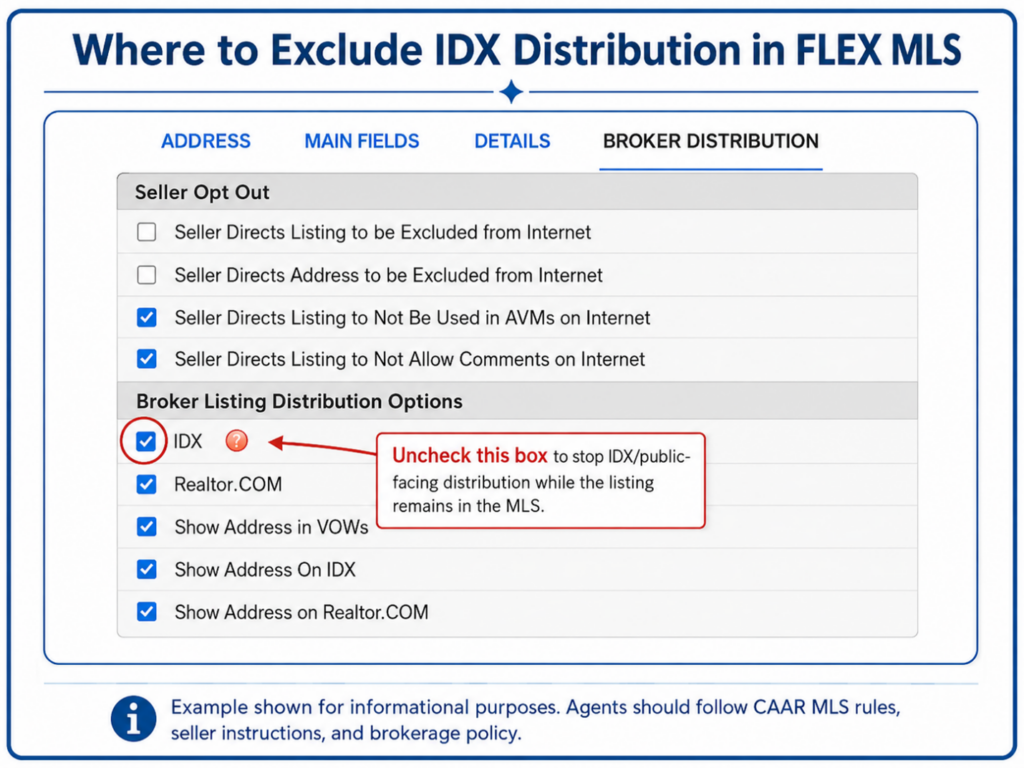
In CAAR’s FLEX MLS system, the IDX option appears in the Broker Distribution section. A seller-directed IDX exclusion keeps the listing in the MLS while limiting selected public-facing distribution.
CAAR’s position is simple: seller choice matters, but it must be informed, documented, and handled under clear rules that protect cooperation and consumer trust. If a seller wants to limit public exposure, the MLS already provides a way to do that through IDX exclusion. CAAR therefore voted against creating a separate IDX marketing delay policy because the functional option already exists within our MLS system.
CAAR has adopted its own Coming Soon status. Under CAAR’s rule, Coming Soon is not IDX marketing delay. That distinction is important because not every MLS uses the term Coming Soon in the same way.
Under CAAR’s rule, Coming Soon is a listing status indicating that a property is not yet available for showings or full market exposure, but will become Active at a future date. A fully executed listing agreement is required before a property can be entered as Coming Soon. A listing may remain in Coming Soon status for a maximum of thirty days, and it will automatically convert to Active when the Coming Soon period expires.
Coming Soon listings are visible only to MLS Participants and Subscribers. They are not syndicated to IDX or public websites.
Most importantly, showings are not permitted while a property is in Coming Soon status.
That rule applies to everyone. The listing agent cannot show the property. Agents within the same brokerage cannot show the property. Other brokerages cannot show the property. Unrepresented buyers cannot be given access. Virtual showings, private previews, office tours, broker opens, and internal previews are not permitted.
This is the bright line CAAR has drawn.
If the property is Coming Soon, it is not available for showings. If the property is shown, previewed, or made available for viewing to any prospective buyer, the listing must immediately be changed to Active status in the MLS.
That is the key difference between CAAR’s Coming Soon status and IDX marketing delay.
With IDX marketing delay, the property may be live in the MLS, available for showings, and open to offers while public website distribution is delayed or withheld. With CAAR’s Coming Soon status, the property is not yet available for showings. It is a pre-active status, not a private showing period.
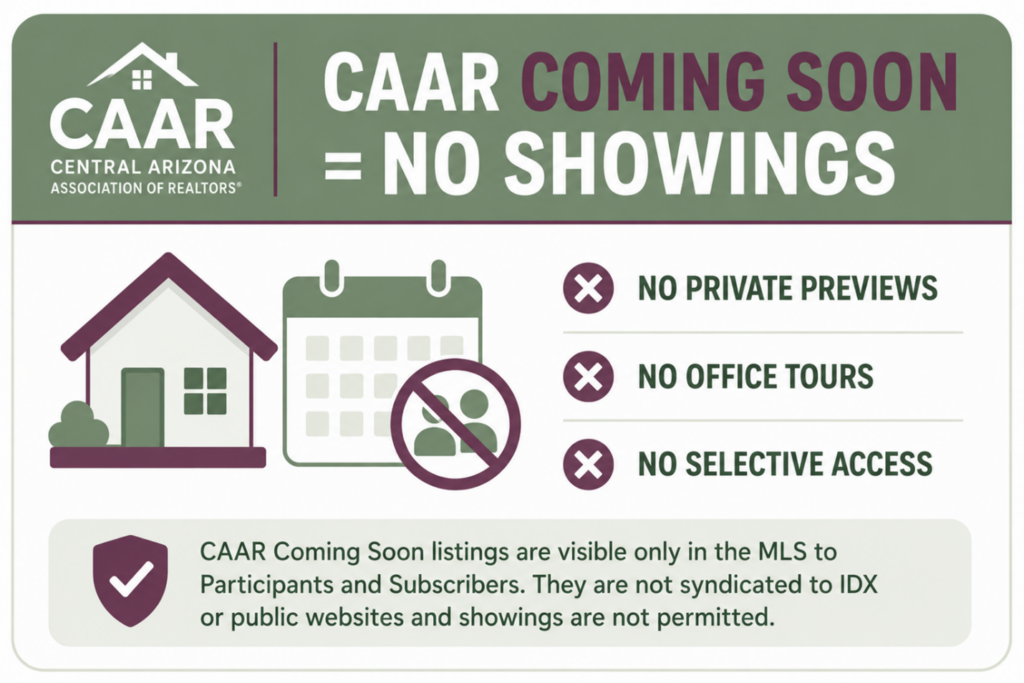
Coming Soon is not intended to create selective access. It is not a way to give one brokerage, one office, one agent, or one group of buyers an early advantage. It is not a way to quietly shop a property to favored buyers while excluding other MLS participants.
The purpose of Coming Soon is practical. It allows a property to be entered into the MLS after a listing agreement is signed, while the seller and listing agent prepare for the property to become Active. That may include photography, cleaning, repairs, staging, seller preparation, or coordinating the timing of full market exposure.
But the rule is clear: no showings.
CAAR’s rule also addresses offer activity. Offers may be presented to the seller while a property is in Coming Soon status. However, if the seller elects to accept an offer, the listing must be changed to Active status before acceptance or concurrently with acceptance.
CAAR has also included an enforcement procedure to protect the integrity of the Coming Soon status. The Listing Participant is responsible for ensuring compliance with the rule and may be required to provide a certification of compliance upon request. That certification may require the Listing Participant to confirm that no showings or selective access occurred during the Coming Soon period.
That enforcement mechanism matters. It helps ensure that Coming Soon does not become delayed marketing by another name. It also protects cooperation among MLS participants by making clear that Coming Soon cannot be used for private previews, internal brokerage showings, or selective access.
The chart below summarizes the key differences among Active listings, Active listings with IDX excluded, CAAR’s Coming Soon status, and IDX marketing delay.
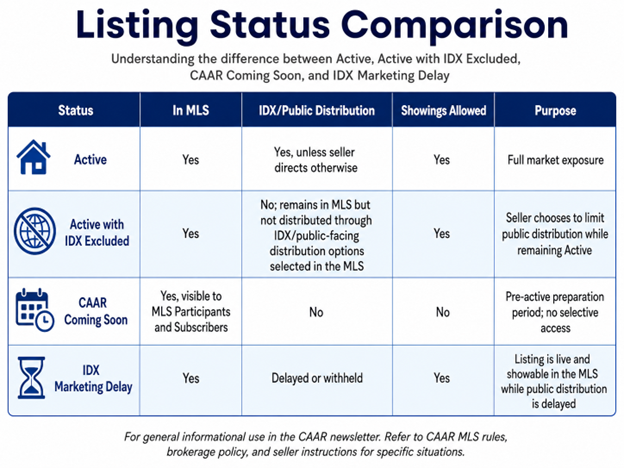
Comparison of listing statuses for general informational purposes. Members should refer to CAAR MLS rules, brokerage policy, and seller instructions in specific situations.
For members, the difference can be summarized this way.
An Active listing is on the market and available for showings. It is generally distributed publicly unless the seller has directed otherwise through available MLS options.
An Active listing with IDX excluded is still on the market and available for showings, but the seller has chosen to limit IDX distribution. In CAAR’s MLS, that option is available by unchecking the IDX box in the Broker Distribution section of the listing input system. The listing remains in the MLS, but it is not syndicated through IDX or public-facing websites.
Under CAAR’s rule, a Coming Soon listing is not yet available for showings. It is visible to MLS Participants and Subscribers, but it is not syndicated to IDX or public websites. No selective access is permitted. If the property is shown, previewed, made available for viewing, or if the seller elects to accept an offer, the listing must be changed to Active as required by the rule
IDX marketing delay, as debated nationally, generally refers to a listing that is live and showable in the MLS, while broader public distribution is delayed or withheld.
These are not the same thing. REALTORS® should be careful not to use the terms interchangeably.
Under the ARMLS rule language, Coming Soon is described as an exempt listing where the seller has directed the listing participant to delay public marketing through IDX and public portal syndication for up to 30 days, and the rule states that Coming Soon does not preclude the listing firm from marketing the listing in a manner consistent with the seller’s choice.
There has been some confusion about ARMLS and delayed marketing. ARMLS is a third-party MLS company, and associations that use ARMLS may make their own policy decisions regarding delayed marketing. Arizona REALTORS® left that issue to the individual associations.
CAAR is speaking only for CAAR. Members who operate outside CAAR should confirm the rules that apply in their MLS or association.
What I can say clearly is that CAAR voted against IDX marketing delay because our MLS already allows a listing to be excluded from IDX distribution indefinitely through the Broker Distribution section of the listing input system.
It is also important not to assume that every MLS uses the term Coming Soon in the same way. Under the ARMLS rules, Coming Soon is described as an exempt listing where the seller has directed the listing participant to delay public marketing through IDX and public portal syndication for up to 30 days, and the ARMLS rule states that Coming Soon does not preclude the listing firm from marketing the listing in a manner consistent with the seller’s choice.
CAAR’s Coming Soon rule is different. Under CAAR’s rule, Coming Soon is a pre-active status with a clear no-showing requirement. The listing agent may not show the property. Other agents may not show the property. There may be no private previews, selective access, office tours, broker opens, or internal showings. If the property is shown, previewed, made available for viewing, or if the seller elects to accept an offer, the listing must be changed to Active as required by the rule. The Listing Participant may also be required to certify compliance upon request.
That is the key distinction for CAAR members: CAAR’s Coming Soon status is not delayed marketing by another name. It is a limited pre-active status with enforceable restrictions designed to protect MLS cooperation, fairness among participants, and consumer confidence.
Seller consent should not be treated as just a signature on a form. It should be a real conversation.
If a seller wants to limit public exposure, exclude the listing from IDX, use Coming Soon, or pursue another limited-exposure strategy, the seller should understand what that decision means. Reduced exposure may affect buyer awareness, showing activity, competition, offer activity, pricing strategy, and the seller’s ultimate result.
There may be valid reasons for limiting exposure. A seller may have privacy concerns. A property may not be ready for showings. Repairs or photography may still be underway. The seller may need time before allowing buyers through the home. In those situations, Coming Soon may be appropriate if the rule is followed. In other situations, the seller may direct the listing agent to exclude the listing from IDX while still making the property Active and available in the MLS.
But whatever the reason, the seller’s decision should be informed and documented.
That is where REALTOR® professionalism matters. Our role is not simply to select a status or check a box in the MLS. Our role is to explain the options, the tradeoffs, and the rules.
This article is intended as general association guidance and does not replace the CAAR MLS rules, brokerage policy, or legal advice for a specific situation.
The national dispute involving Zillow, MRED, and Compass may have started outside Arizona, but the underlying issues are relevant everywhere. Consumers expect access to accurate listing information. Sellers expect REALTORS® to recommend marketing strategies that serve their interests. Buyers expect a fair opportunity to see available homes. MLS participants expect rules that are clear and evenly applied.
For CAAR members, the practical guidance is straightforward.
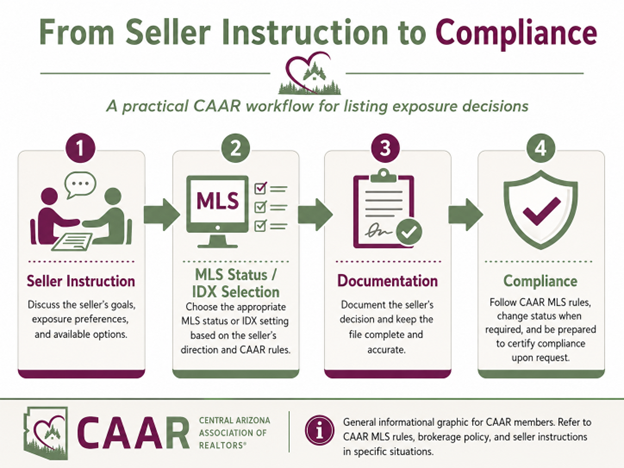
Know the difference between Coming Soon, Active, IDX exclusion, private marketing, and IDX marketing delay.
Remember that CAAR voted against IDX marketing delay because our MLS already allows a listing to be excluded from IDX distribution indefinitely by unchecking the IDX box in the Broker Distribution section.
Explain those options to your sellers.
Document seller instructions when exposure is being limited.
Do not use Coming Soon as a private showing tool.
If a Coming Soon property is shown, previewed, made available for viewing, or if the seller elects to accept an offer, change the listing to Active as required.
Be prepared to certify compliance if requested.
Follow CAAR MLS rules, your brokerage policy, and applicable professional standards.
Most importantly, keep the client’s best interest and public trust at the center of the transaction.
CAAR’s approach is designed to balance seller flexibility with cooperation, transparency, and enforceable rules. We support informed seller choice. We also support a marketplace where REALTORS® understand the rules, apply them fairly, and avoid practices that create confusion or selective access.
In a changing industry, our value as REALTORS® is not just access to listing data. It is judgment, professionalism, local knowledge, and the ability to guide clients through complex decisions with clarity and integrity.
That is the real lesson for CAAR members. CAAR’s Coming Soon status is not IDX marketing delay. Seller choice is important, but it must be informed. And consumer trust remains one of the most valuable things we protect.
Interested in what CAAR does and how you can get involved? Contact us below to talk to our team.