Rim Country Short Term Rentals

Real Estate Sign Rules Across the CAAR Market Area
Payson • Star Valley • Gila County • Coconino County
Written by Dennis Riccio, CAAR President
A real estate sign can look routine, but the legal answer changes quickly when the sign moves from the listed property to a neighboring lot, a roadway median, an HOA common area, or the shoulder of a state highway. There is no single sign rule covering the entire CAAR market area. The first question is always: Where is the sign located?
KEY TAKEAWAY Property-owner permission may be required, but permission alone does not override a town or county sign code, an HOA restriction, an ADOT rule, or a prohibition against signs in a public right-of-way. |
Payson and Star Valley are incorporated towns with their own sign and zoning authority. Pine, Strawberry, Christopher Creek, and Tonto Basin are unincorporated communities governed by Gila County. Happy Jack and Forest Lakes are unincorporated communities governed by Coconino County. Similar-looking roads and neighborhoods can therefore have materially different rules.
Community | Authority | Practical starting point |
Payson | Town of Payson | Town Code plus the Town’s written interpretation provided to CAAR. |
Star Valley | Town of Star Valley | Separate Town zoning ordinance and sign-permit process. |
Pine, Strawberry, Christopher Creek, Tonto Basin | Gila County | County ordinance; parcel zoning classification matters. |
Happy Jack, Forest Lakes | Coconino County | County-wide rules expressly distinguish listing and open-house signs. |
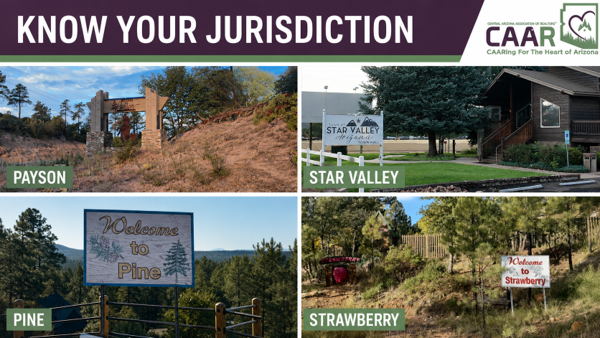
CAAR requested written clarification from the Town of Payson Community Development Department after members raised questions about full-size listing signs being used away from the listed property. The Town responded in writing and explained how it applies §154-05-005(C)(3) to real estate sale, lease, rental, and directional signs.
According to the Town’s written interpretation, a directional sign used in conjunction with the sale, lease, or rental of a specific property is treated as real estate signage under subsection (C)(3), rather than as a general temporary directional sign subject to every requirement of subsection (C)(8). The practical result is:
The Town drew an important boundary: the authorization to use unimproved Town right-of-way applies only to the right-of-way adjacent to the property being offered. It does not authorize directional signs elsewhere along the route. Roadway medians are improved right-of-way, and real estate signs are not permitted in them.
PAYSON EXAMPLE A single directional sign on a nearby private lot, placed with the owner’s permission at a genuine turn, may qualify. A sign in a public-road median or repeated signs along a straight route do not. |
Star Valley is incorporated and does not fall under Gila County’s zoning authority for property inside Town limits. Its posted zoning ordinance contains its own sign standards and the Town maintains a sign-permit application and submittal process.
For R1 residential property, the posted ordinance limits real estate sale signs to a maximum panel area of four square feet and one sign for each 200 feet of street frontage. It also states that signs are not allowed in an existing or projected street right-of-way or street easement. Off-site signs—signs advertising a different property from the one on which they are placed—are addressed under restrictive commercial provisions rather than through the express, permit-free real estate directional-sign interpretation Payson has provided to CAAR.
The practical advice is conservative: do not assume that permission from a neighboring Star Valley property owner authorizes an off-property listing or directional sign. Confirm the parcel’s zoning, applicable permit requirements, and proposed location with the Town before placement. Signs visible from State Route 260 may also implicate ADOT requirements.
The Gila County Planning and Zoning Ordinance applies in Pine, Strawberry, Christopher Creek, and Tonto Basin. The applicable details can vary with the parcel’s zoning classification, so agents should not assume that every property in these communities is governed by the same residential subsection.

Hunter Creek in the Christopher Creek area, Roosevelt Lake Bridge in the Tonto Basin area, and Forest Lakes.
Accordingly, owner permission alone should not be treated as authority for a full listing sign or directional sign on another residential lot. Because the wording differs among R1, RR, GR, SR, SFR, and other districts, agents should identify the zoning classification and confirm any uncertain placement with Gila County Community Development.
Coconino County’s current ordinance is more explicit. It separately addresses on-site sale or rental signs, open-house signs, and prohibited off-premise advertising.
Coconino County generally prohibits billboards and off-premise signs in every zone, but it creates a specific exception for temporary open-house signs:
A continuing full-size listing sign on a neighboring property does not become lawful merely because it points toward the listing. In Happy Jack and Forest Lakes, the clearest off-property exception is the narrow, time-limited open-house provision.

Illustrative example. Coconino County’s temporary open-house-sign exception includes specific limits on size, height, number, duration and placement.
Arizona statutes limit how planned communities and condominium associations may regulate standard for-sale, rent, lease, and open-house signs. Generally, the statutes protect an industry-standard sign up to 18 by 24 inches and a rider up to 6 by 24 inches on the member’s property, subject to the statutory details.
Those protections do not create a general right to place signs on another owner’s lot, an HOA common area, or public land. An association may also prohibit open-house signs on common areas. Agents should therefore check both the local governmental rule and the community documents before placing signs away from the listed property.
ADOT treats a for-sale or lease sign as exempt from the State’s outdoor-advertising permit requirements only when it advertises the property on which the sign is located. A sign advertising a different property is off-premise advertising and may require State approval when it is along a regulated highway. Outdoor advertising signs are not permitted in the state highway right-of-way.
Local approval and private-owner permission do not replace ADOT approval. This issue is particularly important throughout the CAAR market because so many communities and commercial corridors are organized around State Route 260 and other controlled routes.

Signs along State Route 260 may be subject to ADOT outdoor-advertising and right-of-way restrictions in addition to local rules.
BOTTOM LINE The issue is rarely just how many signs an agent has. The controlling questions are where each sign is located, what it advertises, whose property it occupies, and which public or private rules govern that location. |
Town of Payson Code §154-05-005
Town of Star Valley Code and incorporated zoning ordinance
Town of Star Valley sign-permit application
Gila County Planning and Zoning Ordinance
Coconino County Zoning Ordinance, effective January 15, 2026
ADOT Outdoor Advertising Sign Permits
A.R.S. §33-1808 (planned communities)
A.R.S. §33-1261 (condominiums)
Additional source: Written clarification from the Town of Payson Community Development Department to CAAR, August–September 2026, on file with CAAR.
EDUCATIONAL NOTICE This article provides general educational information and is not legal advice. Codes, administrative interpretations, zoning classifications, permit procedures, and HOA rules may change or vary by property. Confirm current requirements with the applicable governmental agency and property association before placing a sign.
Interested in what CAAR does and how you can get involved? Contact us below to talk to our team.