When Sellers Have Second Thoughts


Managing expectations and compensation disputes
By Dennis Riccio | President, Central Arizona Association of REALTORS®
A seller who regrets accepting an offer can put both the transaction and the brokerage’s compensation at risk. Clear expectations help prevent the dispute. If one develops, early broker involvement and careful attention to the signed agreements give everyone a more orderly path forward.
Consider a hypothetical. A homeowner receives a full-price offer shortly after listing and accepts it. A few days later, the seller decides the quick response means the home was underpriced. The seller wants to cancel the sale and try again at a higher price. When that proves complicated, the seller announces that the listing agreement is cancelled and the brokerage will not be paid.
The seller’s concern deserves a calm explanation. It also raises separate questions about the sale, the brokerage relationship, compensation, and the handling of closing funds. Treating all of those as one argument makes the problem harder to resolve.
Discuss pricing, net proceeds, and the possibility of a quick offer before a disagreement develops.
When recommending a price, explain the supporting comparable sales, competing inventory, and the seller’s priorities. Discuss what you would do if a strong offer arrived immediately. An early offer is a reason to evaluate the terms carefully; speed alone does not prove that the property was underpriced.
Review the estimated net proceeds and negotiated compensation before the seller signs the listing agreement, then update the estimate when an offer arrives. Both listing forms expressly state that compensation is fully negotiable. A clear explanation of what the seller agreed to pay is more useful than relying on a signature alone. [1–2]
An offer the seller has not accepted and an accepted purchase contract are different situations. An asking price alone does not settle every term of an offer. Once a contract is accepted, review its actual cancellation rights, contingencies, and performance requirements before telling the seller what options remain.
The listing agreement governs the owner’s relationship with the listing broker. The purchase contract governs the seller’s agreement with the buyer. Cancelling one does not, by itself, cancel the other or erase an existing compensation obligation. Bring the designated broker into the discussion before promising a release or putting the property back on the market.
The September 2025 residential and vacant land listing contracts contain parallel provisions relevant to this hypothetical. Section 4 addresses compensation when the broker produces a ready, willing, and able buyer in accordance with the agreement, as well as a sale during the term. The analysis depends on the entire agreement and the facts, including the buyer’s ability and the offered terms. A full-price offer alone should not be treated as a complete legal analysis. [1–2]
The Withdrawn/Cancelled Listings paragraph states that the same compensation is due if the property is withdrawn without the listing broker’s consent. The Failure to Complete paragraph addresses compensation when the owner’s default, or the owner’s consent, prevents completion. These provisions are reasons to review a cancellation request carefully, rather than assume that a seller can eliminate compensation by ending the listing. [1–2]
A mutually agreed release can have different consequences. Any negotiated cancellation, compensation adjustment, or settlement should clearly say what happens to existing obligations and be approved and signed by the proper parties. Section 3 requires modifications to be in writing signed by the owner and listing broker. [1–2]
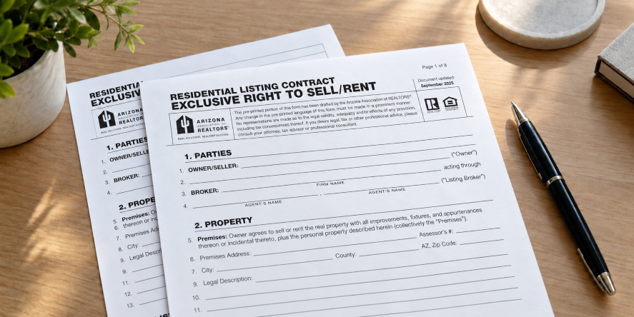
The listing agreement and purchase contract address different obligations.
Both listing forms instruct escrow to pay the compensation “as a condition to closing” and upon escrow cancellation and assign owner proceeds to the broker to the extent necessary. Send the signed compensation documents to escrow early and confirm the expected payment. [1–2]
If the seller objects, ask escrow in writing what funds are held, which instructions govern them, and precisely what is needed for disbursement. Provide the documents to the designated broker and counsel. The existence of payment language does not establish that escrow can adjudicate a contested claim or simply ignore conflicting instructions.
Be particularly careful with Section 4’s Broker (Dispute) paragraph. Its direction to resolve compensation disputes after closing concerns disputes between the listing broker and other brokers. It is not a blanket instruction to postpone every seller–broker payment dispute until the buyer has moved in. [1–2]
A brokerage should not improvise a holdback, waive compensation rights, or use the buyer’s transaction as bargaining pressure. Counsel can help address the closing obligations and compensation claim together, including whether a documented holdback or other arrangement is appropriate and what consents are required.
Section 9 of both listing forms begins with a contractual commitment: “Owner and Listing Broker (“Parties”) agree to mediate any dispute or claim arising out of or relating to this Agreement.” It allocates mediation costs equally. If mediation does not resolve the dispute, the form calls for binding arbitration, with an agreed arbitrator or an American Arbitration Association fallback. [1–2]
There is an important qualification. Either party may opt out of binding arbitration by notice within 30 days after the conclusion of the mediation conference, after which either may resort to court action. Calendar that deadline and follow the agreement’s written-notice requirements. If the other party never attends mediation, ask counsel how to proceed; do not assume that a refused invitation starts that 30-day clock. [1–2]
Association procedures and contractual obligations also need to be distinguished. NAR’s arbitration rules require a client’s voluntary agreement to use the association’s arbitration process. Arizona REALTORS® offers business-dispute mediation when all parties agree to participate. Neither point means that a client can necessarily disregard an enforceable dispute-resolution provision already signed in a listing agreement. [3–4]
If a party refuses to cooperate, counsel should assess the agreement, required preliminary steps, and the appropriate forum. Arizona law provides a process for seeking a court order compelling arbitration when an enforceable agreement applies. That is a possible enforcement route, not a guarantee that every dispute must be arbitrated or that the brokerage will prevail. [5]
Have the designated broker or counsel send a measured written demand identifying the amount claimed, the contractual basis, and the requested payment or release authorization. Invite the seller to explain any disputed facts and propose a mediator with practical dates. Preserve the signed forms, pricing analysis, offer history, relevant messages, and escrow correspondence.
Evaluate settlement against the amount at issue, likely expense, delay, and collectability. Section 9 provides for reasonable attorney fees and costs to the prevailing party, so fee exposure can run in either direction. Explain that risk accurately rather than promising that the seller will pay every dollar spent. Any settlement should resolve the payment and release terms in writing. [1–2]
Our strongest opportunity is often the first conversation: explain what a successful offer may look like, review the net proceeds, and discuss obligations before disappointment becomes a dispute. When disagreement persists, involve the broker early and follow the agreement with a clear written record.
General member education based on the forms identified below. The executed agreements, amendments, facts, and applicable law control. Obtain advice from the designated broker and qualified counsel for an actual dispute.
Contract Reference Guide
Companion reference for readers and newsletter production. References use printed contract pages and numbered lines. Quotations in the article are selected excerpts; read the complete provisions.
Provision | Residential [1] | Vacant land [2] | Practical significance |
Term and changes | §3, p1 | §3, p1 | Rights and obligations extend through actual closing after a sale contract is fully executed. Modifications require a writing signed by owner and listing broker. |
Negotiated compensation | §4, p2 | §4, p2 | Compensation is fully negotiable. The payment obligation includes producing a ready, willing, and able buyer in accordance with the agreement, or a sale during the term. |
Cancellation and failure to complete | §4, p3 | §4, p3 | Addresses withdrawal without broker consent and failure to complete through owner default or consent. Read with the construction language and applicable law. |
Escrow payment | §4, p3 | §4, p3 | Directs payment as a condition to closing or upon escrow cancellation and assigns necessary owner proceeds. A disputed disbursement requires review of all governing instructions. |
Dispute between brokers | §4, p3 | §4, p3 | The after-closing dispute provision addresses compensation disputes between brokers. It does not state the same rule for a seller refusing payment. |
Mediation and arbitration | §9, p7 | §9, p7 | Mediation first, equal mediation costs, then arbitration if unresolved. Either party can opt out within 30 days after the mediation conference concludes. |
Fees and notices | §9, p7, lines 287–289 | §9, p7, lines 271–273 | Prevailing party is entitled under the form to reasonable attorney fees and costs. Notices must follow the specified delivery rules; days are calendar days unless otherwise provided. |
The additional February 2026 purchase form [6] governs the buyer–seller relationship. Section 7a–b (p7, lines 299–310) addresses cure and breach; §7c (p7, lines 311–320) addresses ADR, subject to §7d exclusions (pp7–8, lines 321–327); §7e (p8, lines 328–330) addresses buyer–seller attorney fees. Section 8f (p9, lines 369–376) recognizes compensation under separate written agreements and addresses payment at closing. These provisions should be read separately from the owner–broker remedies in the land listing agreement.
Sources and Publication Notes
Editor reference. Publish the article and optional contract guide together; keep the production notes below separate from the member-facing copy.
[1] Arizona Association of REALTORS®, Residential Listing Contract – Exclusive Right to Sell/Rent, updated September 2025, eight pages. Supplied attachment ending 20261024124513.pdf. © 2025 Arizona Association of REALTORS®. Section and line references in the article and guide refer to this version.
[2] Arizona Association of REALTORS®, Vacant Land/Lot Listing Contract – Exclusive Right To Sell/Lease, updated September 2025, eight pages. Supplied as lot listings.pdf. © 2025 Arizona Association of REALTORS®. References use this version’s printed page and line numbers.
[3] National Association of REALTORS®, Code of Ethics and Arbitration Manual, Part Ten, Section 44(a)(2), dated January 1, 2026. Addresses client consent to association arbitration.
NAR duty and privilege to arbitrate
[4] Arizona REALTORS®, Mediation of a Business Dispute Process. Describes participation by agreement and the association’s mediation service.
Arizona REALTORS business dispute mediation
[5] A.R.S. §12-3007, Motion to compel or stay arbitration. Provides the enforcement process for an applicable, enforceable arbitration agreement.
Arizona statute on compelling arbitration
[6] Arizona Association of REALTORS®, Vacant Land/Lot Purchase Contract, updated February 2026, ten contract pages plus buyer attachment. Supplied attachment ending 20261024124726.pdf. © 2026 Arizona Association of REALTORS®. References exclude the buyer attachment from page numbering.
Online sources checked October 24, 2026. Contract explanations are based on the AAR versions, not a representation that every Arizona brokerage uses identical forms.
Interested in what CAAR does and how you can get involved? Contact us below to talk to our team.