When Sellers Have Second Thoughts

Melissa Glinzak shares what REALTORS® should investigate before clients buy or sell in an HOA-governed community.
SEPTEMBER 2, 2026 • CHAPARRAL PINES • 65 MEMBERS
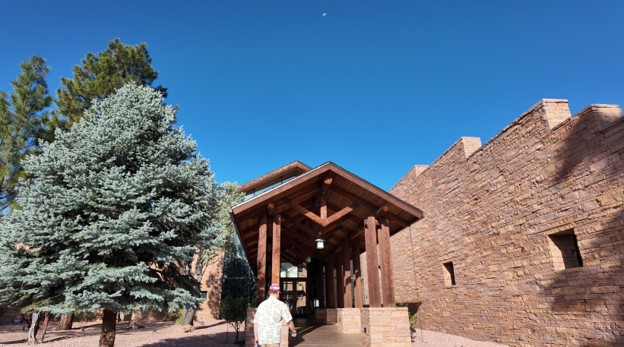
CAAR welcomed 65 members to its Business Breakfast on Wednesday, September 2, at Chaparral Pines. Featured speaker Melissa Glinzak, CAAM, MBA, Executive Vice President of Northern Arizona Operations for Ogden & Company, Inc., presented “What in the HOA??” – a practical discussion of homeowners associations and the questions REALTORS® should investigate when representing buyers and sellers.
The central message: Do not judge an HOA by its appearance, its name, or a single MLS field. Read the governing documents and understand what the association actually owns, maintains, funds, and restricts. |
THE CONVERSATION BEGINS

Melissa Glinzak’s presentation balanced the potential benefits of HOA living with the concerns buyers frequently express.
Melissa began by looking at both sides of HOA ownership. Potential advantages include retained or increased property values, a consistent neighborhood appearance, safety, shared maintenance costs, and a structured way to resolve disputes. Common objections include too many rules, regular assessments and special assessments, limits on personal choices, fear of enforcement, and community drama.
Her point was not that every client should choose an HOA. Instead, REALTORS® should understand the reason behind a client’s concern. A buyer who says “no HOA” may be worried about affordability, restrictions, rental plans, or a prior bad experience. Identifying the real concern makes it possible to evaluate the specific community instead of relying on broad assumptions.
CLASSIFICATION MATTERS
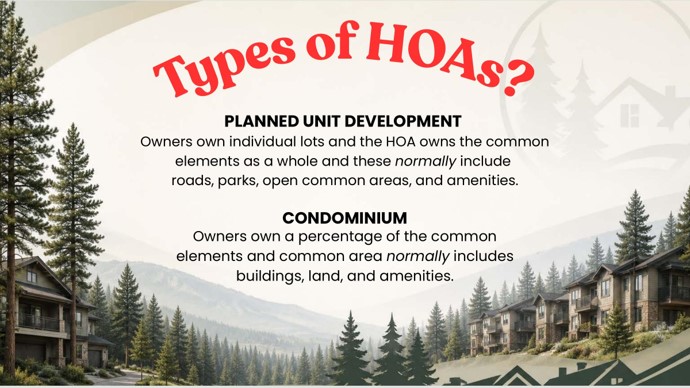
The legal structure – not the property’s outward appearance – determines whether a community is a planned unit development or condominium.
Melissa explained that community associations may be called HOAs, POAs, condominium associations, councils of co-owners, or community associations. Whatever the label, the underlying legal structure and governing documents determine ownership and responsibility.
In a typical planned unit development, owners hold title to their individual lots and the association owns or maintains designated common elements. In a condominium, each owner generally owns a unit together with an allocated interest in the common elements. Those distinctions can affect financing, insurance, maintenance obligations, reserve requirements, and future expenses.
QUESTIONS FROM THE ROOM
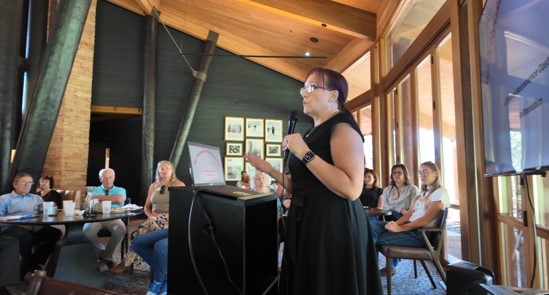
Melissa Glinzak answers member questions during CAAR’s September Business Breakfast.
The question-and-answer session explored communities with recorded CC&Rs but no active association – or an association that has collected little money and rarely enforced its restrictions. Melissa described some as “paper” or dormant associations. Members discussed the difficulty of determining what obligations remain after years of inactivity.
Members were reminded that the absence of an active HOA does not necessarily erase recorded restrictions. Depending on the documents and circumstances, neighboring property owners may retain private enforcement rights. That point is especially important when a buyer plans to operate a short-term rental in a community whose recorded CC&Rs restrict rentals.
The discussion also distinguished fines from assessments and examined how balances, unresolved violations, disclosure fees, or incomplete records may surface during escrow. Self-managed associations can present added challenges when boards are unfamiliar with statutory requirements or have not maintained complete financial and governance records.
A reserve study evaluates the useful life and projected replacement cost of major common components such as roads, roofs, parking areas, and amenities. Comparing the plan with actual reserves can help reveal whether owners may face substantial future assessments. Melissa encouraged REALTORS® to pay particular attention when an association owns private roads or other expensive infrastructure.
PRACTICAL DUE DILIGENCE
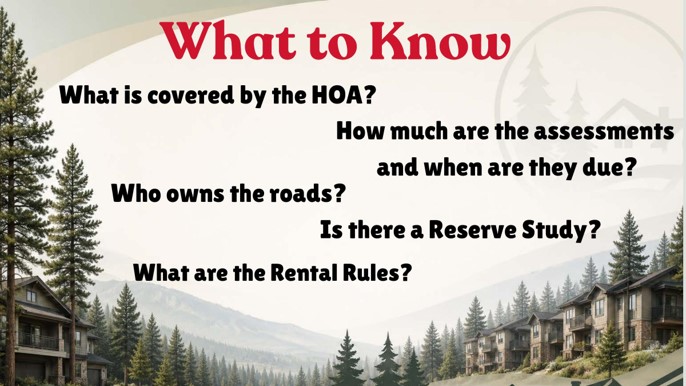
Melissa’s closing checklist focused on maintenance, assessments, road ownership, reserve planning, and rental rules.
Before a client commits to a property, Melissa encouraged members to look beyond the amount of the regular assessment and gather a fuller picture of the association.
A maintenance matrix, budget, reserve study, plat, deed, CC&Rs, amendments, and resale-disclosure package can help answer these questions. This becomes particularly important when a buyer is near the top of a housing budget and may not be prepared for substantial assessments.
A useful client conversation: Ask what the buyer hopes to do with the property and what specifically concerns the buyer about an HOA. Rental plans, pets, exterior changes, parking, affordability, and maintenance expectations can each lead to a different set of documents and questions. |
MEMBER ENGAGEMENT

Sixty-five CAAR members attended the September 2 program and contributed questions and real-world experiences.
The morning’s most important takeaway was simple: REALTORS® should not assume they understand a community from its appearance, its MLS classification, its marketing name, or whether an active HOA is immediately visible.
Reviewing the deed, plat, CC&Rs, amendments, disclosures, financial statements, reserve information, maintenance obligations, and rental restrictions can help clients make informed decisions and reduce unwelcome surprises after closing.
The session closed with members sharing their own experiences, including the value of constructive service on an association board. An informed owner who becomes involved can sometimes help an association resolve long-running disputes and improve its operations.
Thank you, Melissa: CAAR thanks Melissa Glinzak for sharing her experience and practical knowledge, Chaparral Pines for hosting the breakfast, and all 65 members who joined us for another well-attended educational program. |
Educational notice
This recap is provided for general educational purposes and is not a substitute for legal, lending, insurance, accounting, or tax advice. Association documents and the circumstances of each transaction should be independently reviewed.
Interested in what CAAR does and how you can get involved? Contact us below to talk to our team.