From the Capitol to the Closing Table

Legislative progress, Arizona’s housing challenge, and what comes next
By Dennis R. Riccio, 2026 CAAR President
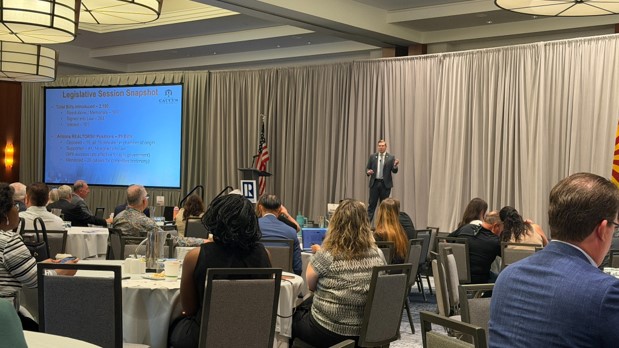
Arizona REALTORS® members gathered at the Sheraton Phoenix Downtown as Tim Beaubien reviewed the 2026 legislative session. Photo by Dennis R. Riccio.
On August 20, REALTORS® from across Arizona gathered at the Sheraton Phoenix Downtown for the 2026 Arizona REALTOR® Caucus. The program connected two subjects that can sometimes feel separate: the work of advocacy at the State Capitol and the economic pressures confronting buyers, sellers, property owners, and communities. In reality, the two are closely linked. Laws governing property rights, disclosure, insurance, water, permitting, and housing development ultimately affect what happens at the closing table.
Two presentations were especially relevant to CAAR members. Tim Beaubien, Senior Director of Government Affairs for Arizona REALTORS®, reviewed the 2026 legislative session and previewed priorities for 2027. Keynote speaker Katie Ratlief, Executive Director of Common Sense Institute Arizona, then examined why Arizona has become less affordable and why housing supply remains central to the solution.
CENTRAL TAKEAWAY Protecting property rights and expanding housing supply are not competing objectives. They are complementary parts of a healthy real estate market. |
Arizona lawmakers introduced 2,190 bills, resolutions, and memorials during the 2026 session. Of those, 264 were signed into law and 151 were vetoed. Arizona REALTORS® took positions on 89 bills: it opposed 19, supported 41, and monitored 29 so that the association could provide testimony and technical input without immediately taking a formal side.
According to Beaubien, all 19 bills opposed by Arizona REALTORS® were defeated in their chamber of origin. Fourteen of the 41 supported bills became law—a 34% success rate in a session marked by narrow legislative majorities and a governor of the opposing party. He described Arizona REALTORS® as the “Purple Party”: focused on real estate and private-property policy rather than partisan labels.
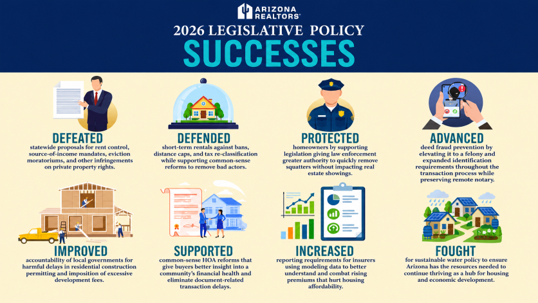
The 2026 policy summary highlighted victories involving private-property rights, deed fraud, unlawful occupants, HOA disclosures, insurance data, permitting, and water policy. Clean recreation based on the conference slide.
The legislative update included several measures that REALTORS® should understand because they affect transactions, ownership risks, or client counseling.
SB 1479 strengthens protections against deed fraud. Knowingly recording a forged, groundless, or false real-property claim becomes a class 5 felony rather than a class 1 misdemeanor. The law adds identification and notary-journal requirements for specified in-person real-estate documents, while preserving an exception for qualifying remote online notarizations. It also directs county assessors to offer owners an opt-in notification system by January 1, 2027, alerting them when a change in ownership or mailing address is reported.
For REALTORS®, the practical lesson is straightforward: encourage property owners—especially owners of vacant land, second homes, and properties held for long periods—to enroll in available recorder and assessor alerts. Early notice cannot prevent every fraud attempt, but it can dramatically improve the chance of stopping or correcting one before it becomes a title crisis.
SB 1426 expands the forcible-entry-and-detainer process for an unauthorized person occupying a residential property under defined conditions and directs the Arizona Supreme Court to adopt rules for expedited resolution. The legislation expressly preserves the rights and remedies of landlords and tenants under the Residential Landlord and Tenant Act. That distinction matters: the measure addresses unlawful occupants, not ordinary tenant disputes or legitimate real-estate showings.
HB 2397 substantially expands the information required in condominium and planned-community resale disclosures. Depending on the type and size of the association, the disclosure package includes additional financial information, recent open-meeting minutes, reserve and litigation information, special-assessment details, unresolved violations, insurance information, and other facts that can affect a buyer’s decision. The law generally requires delivery within ten days after the statutory notice and acceptance conditions are met.
This is a meaningful transaction improvement. A special assessment, underfunded reserve account, pending lawsuit, insurance limitation, or unresolved violation can materially change affordability and risk. Earlier and more complete information gives buyers and their REALTORS® a better opportunity to evaluate the community before deadlines expire.
HB 2174 addresses the growing use of predictive models in insurance rate filings. Modeling organizations must file organizational information with the Arizona Department of Insurance and Financial Institutions, and the department may require supporting data before approving a predictive model for use by insurers. The legislation does not solve Arizona’s insurance affordability problem, but it seeks more transparency and accountability for models that may influence premiums and insurability.
Short-term rentals received considerable attention. Arizona REALTORS® opposed proposals for outright bans, distance requirements, numerical caps, and tax reclassification. Beaubien emphasized, however, that defending lawful property use does not mean defending unsafe or disruptive operators. Arizona REALTORS® supported HB 2429, a proposal that included occupancy limits, a longer period for the “three strikes” rule, guest background-check provisions, and potential suspensions for unpaid fines or building-code violations. The bill did not become law, but the association’s support illustrated a willingness to pursue targeted regulation rather than blanket prohibition.
That distinction is especially relevant in Rim Country. Short-term rentals contribute to the tourism economy and provide owners with a lawful use of their property, while neighborhood quality of life and responsible operation also deserve protection. The strongest policy approach is likely to focus on conduct, safety, enforceable nuisance standards, and removal of repeat bad actors—not arbitrary limits that create different property values based on government-issued scarcity.
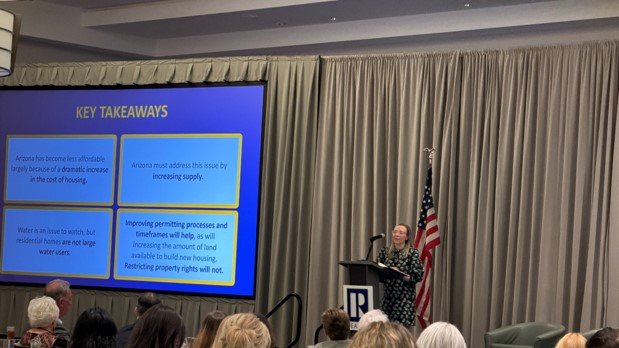
Katie Ratlief, Executive Director of Common Sense Institute Arizona, summarized CSI’s research on housing affordability and supply. Photo by Dennis R. Riccio.
Katie Ratlief’s presentation placed these legislative debates in a broader economic context. Common Sense Institute compared household incomes with six major expense categories—housing and utilities, groceries, health insurance, automobile insurance, gasoline, and child care. CSI’s conclusion was that Arizona had fallen from the 33rd-most-affordable jurisdiction in 2019 to 40th when the states and Washington, D.C., were compared, placing Arizona among the seven least affordable.
Housing was the largest contributor. CSI reported that Arizona housing prices were more than 50%, or approximately $142,000, higher than at the end of 2019. The institute estimated that a household now needs approximately $87,000 in annual income to afford a typical home. Using its assumptions about prevailing mortgage costs, a 20% down payment, and housing expense not exceeding 28% of income, CSI calculated that only 42% of Arizona households could afford the monthly payment on a new mortgage in 2024.
WHY IT MATTERS Affordability is not only a buyer qualification problem. It affects workforce recruitment, household formation, mobility, local business growth, and whether longtime residents can remain in their communities. |
CSI estimated Arizona’s immediate 2025 housing shortage at 55,992 units, a 5.1% increase from 2024. At the then-current permitting rate, its model projected that the statewide deficit would take approximately 119.6 years to close if demand stopped growing. The statewide figure is heavily influenced by large metropolitan counties, so the county-level results provide a more useful local perspective.
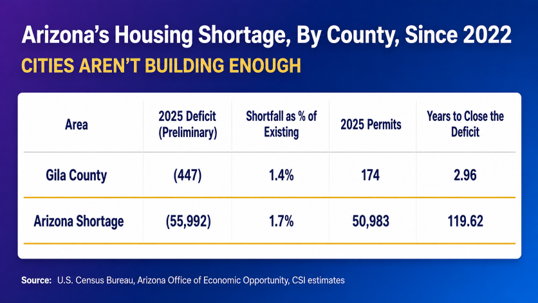
CSI’s preliminary county table estimated a 447-unit housing deficit in Gila County, with 174 permits in 2025 and approximately 2.96 years to close the gap at that pace. Clean recreation based on the conference slide.
For Gila County, CSI’s preliminary table estimated a 447-unit deficit in 2025, equal to roughly 1.4% of the existing housing stock. With 174 permits, the model estimated approximately 2.96 years to close that deficit. That is considerably more manageable than the statewide projection, but it should not be read as evidence that every Rim Country segment is adequately supplied. Entry-level ownership, workforce housing, buildable land, infrastructure, construction costs, and the mix of homes being permitted all matter. A county can add units while still failing to produce the type or price point local workers and first-time buyers need.
What the statewide data says—and does not say—about STRs
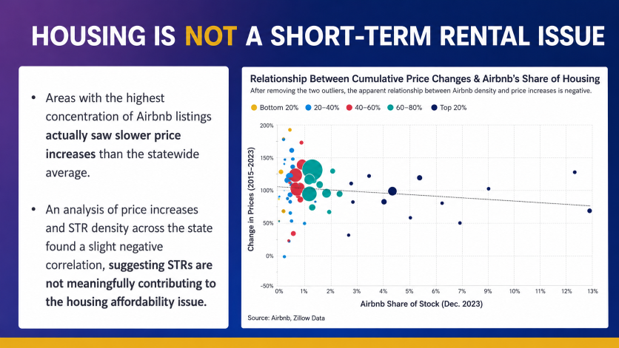
CSI reported that, after excluding identified outliers, its statewide analysis did not find greater short-term-rental concentration associated with faster housing-price growth. Clean recreation based on the conference slide.
CSI also examined the relationship between short-term-rental concentration and housing-price growth. Ratlief reported that, after removing identified outliers, communities with the highest concentration of Airbnb listings had experienced slower price increases than the statewide average, producing a slight negative correlation in the institute’s analysis. CSI therefore did not find statewide evidence that short-term rentals were a meaningful cause of Arizona’s affordability problem.
The presentation further suggested that many short-term rentals compete primarily with second-home and vacation-home uses rather than with conventional workforce rentals. That is an important statewide finding, but correlation does not establish that STRs have no local effects. Tourism communities can experience neighborhood-level price premiums, land-use conflicts, seasonal workforce shortages, or differences between HOA-restricted and unrestricted properties. For Rim Country, the responsible conclusion is neither “STRs cause the housing shortage” nor “STRs have no impact.” It is that statewide affordability cannot be solved simply by restricting short-term rentals, and local policy should be based on specific evidence and clearly defined problems.
Ratlief’s policy prescription focused on supply. CSI reported that the State Land Trust owns approximately 13% of Arizona—about nine million acres—and that a meaningful share is near population centers. The institute estimated that a deliberate program to make appropriate trust land available for development could add substantial housing supply and reduce prices. Beaubien likewise identified public-private partnerships, state-land review, rural affordable-housing incentives, expedited permitting for “missing middle” housing, and better use of public land as priorities for 2027.
The caucus also highlighted laws intended to discourage malicious municipal delay in single-family permitting and to limit certain excessive development fees. These policies reflect a basic reality: safety, infrastructure, water, and responsible planning are essential, but unpredictable processes and costs can prevent otherwise viable entry-level housing from being built.
Water policy will remain central. Arizona REALTORS® supported technical changes to the 100-year assured-water-supply process and advocated closing the different treatment of single-family build-to-rent subdivisions and for-sale subdivisions. Those proposals did not all become law, but they will continue to shape the debate. The Colorado River operating framework also remains unsettled, and the lower-basin states are pursuing an interim approach while longer-term allocations are negotiated.
For Rim Country, water questions vary greatly by community, utility, well, and development pattern. REALTORS® should avoid broad assurances and continue directing buyers to the appropriate water provider, public records, inspections, and professional advice. At the policy level, conservation and infrastructure must advance alongside responsible housing production.
The value of the REALTOR® Caucus is not simply learning which bills passed. It is understanding how advocacy, economics, and day-to-day practice fit together. Five practical lessons stand out:
Arizona’s affordability challenge will not be solved by one bill or one legislative session. The 2026 caucus nevertheless demonstrated that sustained advocacy can produce meaningful improvements—from felony penalties for deed fraud and faster remedies for unlawful occupants to stronger HOA disclosures and greater scrutiny of insurance models. The next phase must connect those protections with a sustained commitment to housing supply.
CLOSING THOUGHT REALTORS® see the consequences of public policy one household at a time. That practical experience is why our participation in advocacy—and our willingness to bring accurate information back to our communities—matters. |
This article summarizes presentations delivered by Tim Beaubien and Katie Ratlief at the 2026 Arizona REALTOR® Caucus on August 20, 2026. Legislative descriptions were checked against Arizona Legislature materials for SB 1479, SB 1426, HB 2397, and HB 2174. CSI figures reflect the slides presented at the caucus and should be described as CSI estimates or preliminary estimates where indicated.
Interested in what CAAR does and how you can get involved? Contact us below to talk to our team.