When Sellers Have Second Thoughts

A first-time buyer finds an affordable manufactured home but struggles to obtain suitable financing. A veteran worries that a seller will reject an offer using VA financing. A custom-home appraisal is delayed because few appraisers serve the area.
These may appear to be separate problems, but each reflects a larger challenge facing rural housing markets.
On July 11, 2026, the bipartisan 21st Century ROAD to Housing Act became federal law. The legislation brings together nearly 50 housing measures intended to increase housing supply, reduce regulatory barriers, modernize federal housing programs, improve access to financing, and expand opportunities for homeownership.
It is one of the most substantial federal housing packages enacted in decades. It is also the result of nearly two years of sustained advocacy by the National Association of REALTORS® and REALTORS® throughout the country.
The law will not reduce home prices or mortgage rates overnight. Many provisions still require federal regulations, studies, pilot programs, funding decisions, or participation by local governments and lenders. However, several parts of the law could eventually be meaningful to REALTORS® and consumers in Payson, Pine, Strawberry, Happy Jack, and the surrounding Rim Country.
The central idea behind the legislation is straightforward: The country does not have enough housing in the places and price ranges where it is needed.
The ROAD to Housing Act gives communities additional tools to plan for housing growth and seeks to streamline federal requirements that can delay or increase the cost of development. It also directs the U.S. Department of Housing and Urban Development to develop best-practice frameworks for zoning and land-use policies.
The legislation does not impose a single development model on every community. That distinction is important in Rim Country. A housing solution that works in Phoenix may not be appropriate for a rural mountain community with limited infrastructure, water considerations, wildfire risks, difficult terrain, and a strong interest in preserving community character.
Our local housing discussion should not simply be about building more homes. It should consider the types of housing our communities need and can responsibly support.

That includes starter homes, workforce housing, senior housing, manufactured homes, rentals, and opportunities for existing residents to remain in the communities where they live and work. Teachers, healthcare workers, public-safety employees, hospitality workers, and other members of our local workforce all need realistic housing options.
Federal policy may provide additional tools, but local governments and communities will still need to decide how those tools fit their needs, infrastructure, and long-term plans.
Several provisions of the ROAD to Housing Act connect directly to challenges CAAR members encounter in Rim Country transactions.
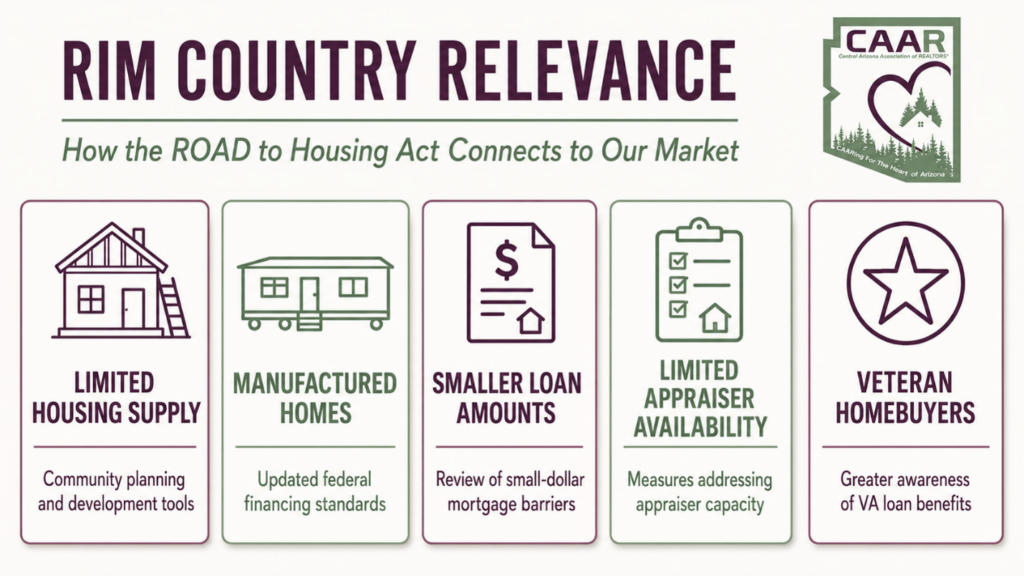
Manufactured and rural housing provide one of the clearest examples of how these national policy changes may eventually affect our local market.
Manufactured housing is an important part of the housing supply in rural Arizona. Several provisions of the new law may therefore be especially relevant to our area.
The law updates federal lending standards for manufactured housing and directs additional study of financing for factory-built homes. Buyers of manufactured homes can face challenges involving the foundation, title status, age and condition of the home, whether the land is owned or leased, appraisal requirements, insurance, and lender eligibility standards.
The legislation could eventually improve financing opportunities, but it does not mean every manufactured home will qualify for a loan. REALTORS® should continue identifying potential issues early and working with lenders who have experience with the particular property type.
The law also addresses rural housing programs and barriers affecting smaller-dollar mortgages. Lower-priced homes are not necessarily easier to finance. A relatively small mortgage can require much of the same underwriting and origination work as a larger loan, making some lenders less willing to offer them.
This can create a frustrating gap in rural markets. A buyer may find a home within an affordable price range but have difficulty locating an appropriate loan product.
The law requires further review of barriers affecting smaller-dollar mortgages. If those barriers can be reduced, buyers in smaller and more affordable markets may eventually have access to more financing options.
The law may eventually improve housing supply and financing options, but it does not change today’s mortgage rates or guarantee that a particular buyer or property will qualify.
The legislation also includes measures intended to strengthen the appraisal workforce, including changes affecting who may perform appraisals for certain FHA-insured transactions.
This could matter in rural areas where qualified appraisers may be limited and may need to travel considerable distances. A shortage of appraisers can increase costs and delay transactions.
However, expanding the number of eligible appraisers will not eliminate the complexities of rural valuation. Custom construction, acreage, manufactured homes, wells, septic systems, outbuildings, unpermitted improvements, and limited comparable sales can all complicate an appraisal.
Listing agents can help by preparing accurate property information, identifying significant improvements, confirming permitted living area when possible, and making relevant comparable sales available without attempting to influence the appraiser’s opinion of value.
Buyer agents should prepare their clients for the possibility that an unusual or rural property may require additional appraisal time, documentation, or review.
The ROAD to Housing Act includes measures intended to strengthen awareness of VA home-loan benefits and improve housing assistance for certain veterans.
Veterans are sometimes discouraged from using VA financing because of misconceptions about appraisals, property requirements, closing costs, or the strength of a VA-financed offer. REALTORS® should avoid assuming that conventional financing is always more attractive to a seller.
The financing should be evaluated as one part of the entire offer. Relevant considerations include the buyer’s qualifications, available funds, contingencies, proposed timeline, lender performance, and the property’s condition.
Agents working with veteran buyers should understand the basic features of VA financing and involve an experienced VA lender when questions arise.
The legislation also addresses purchases of single-family homes by certain large institutional investors. The stated goal is to reduce competition between major investment entities and individual homebuyers.
Institutional ownership is a larger issue in some metropolitan markets than it is in Rim Country. Most local investment properties are owned by individuals, small investors, vacation-home owners, or short-term rental operators. REALTORS® should not assume that every investor or business entity is covered by the new law.
The statutory definitions and future implementation guidance will determine which investors and transactions are affected.
Enactment is only the first step.
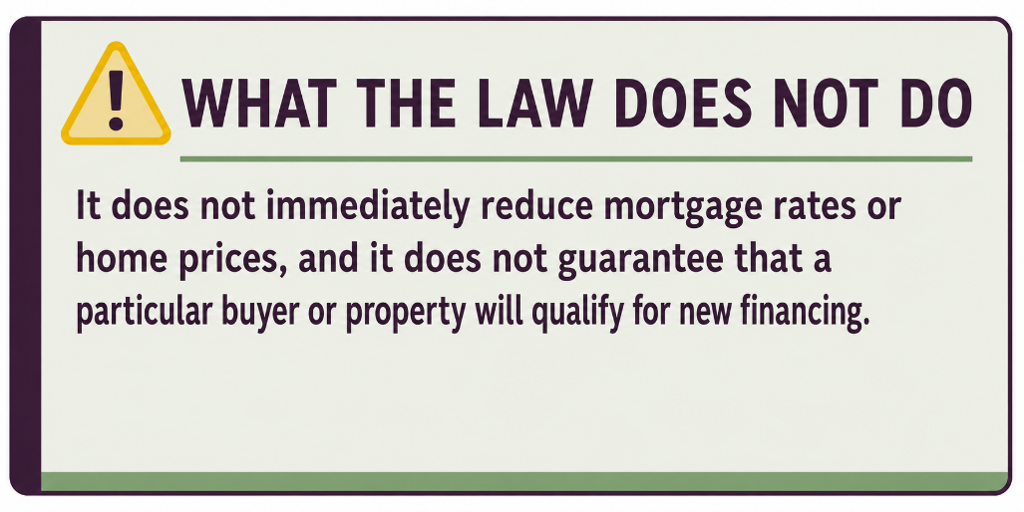
Some provisions may be implemented relatively quickly. Others require federal agencies to develop regulations, conduct studies, establish pilot programs, or distribute funding. New housing also takes time to plan, approve, finance, and construct.
Local land availability, infrastructure, construction labor, insurance costs, interest rates, and community planning will continue to affect affordability. The new law does not resolve all of those challenges.
REALTORS® should be cautious about telling a client that a new benefit or financing option is already available. Until agencies and lenders provide implementation guidance, the safest approach is to explain that the law establishes a framework for future changes.
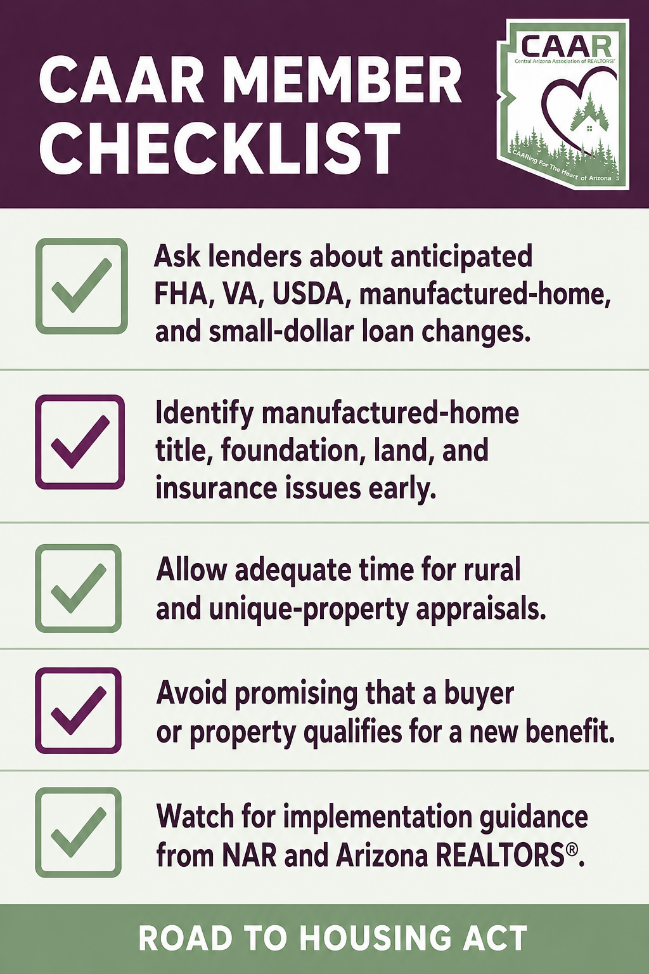
CAAR members can begin preparing for the law’s implementation by taking several practical steps:
Now | Over the coming months | Longer term |
The legislation is law | Agencies develop rules, studies and programs | Communities, lenders and consumers may see practical effects |
Existing loan requirements remain in place | Lenders evaluate program changes | Financing or housing-supply options may expand |
Members should monitor guidance | CAAR shares relevant updates | Local results will vary |
The passage of the ROAD to Housing Act is also an example of why REALTOR® advocacy matters.
When REALTORS® participate in calls for action, legislative meetings, RAPAC, and policy discussions, those efforts may seem far removed from an individual transaction. This legislation demonstrates how sustained REALTOR® involvement can eventually produce changes affecting financing, housing supply, veterans, rural communities, and access to homeownership.
That advocacy will remain important at the state and local levels. Arizona communities must continue addressing infrastructure, water, insurance, construction costs, private property rights, and the housing needs of local workers and families.
REALTORS® bring an important perspective to those discussions because we work directly with buyers, sellers, property owners, lenders, appraisers, builders, and communities.
No single federal law will solve Rim Country’s housing challenges. Land, infrastructure, construction costs, insurance, financing, and community planning will continue to shape our market. Still, the ROAD to Housing Act represents a meaningful effort to address some of the barriers our members and clients encounter every day.
CAAR will continue following the law’s implementation and helping members separate the changes that matter locally from the headlines that do not.
Sources: National Association of REALTORS®, U.S. House Committee on Financial Services, and the congressional section-by-section summary.
Interested in what CAAR does and how you can get involved? Contact us below to talk to our team.