Rim Country Short Term Rentals

Spring 2026 | CAAR Market Insight
From the Desk of Dennis R. Riccio, President
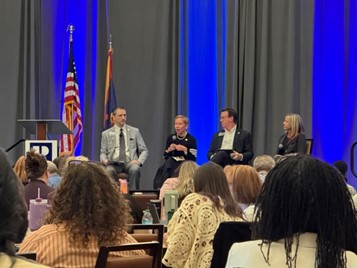
One of the most important sessions I attended at the 2026 Arizona Association of REALTORS® Spring Conference in Phoenix focused on a topic that directly impacts every one of us: advertising compliance.
AAR attorney Aaron Green delivered a clear and urgent message on behalf of the Arizona Department of Real Estate (ADRE): enforcement is no longer passive. It is active, aggressive, and already underway.
This is not theoretical. Agents across Arizona are already receiving notices.
ADRE is not just educating. They are enforcing.
According to Green, the Department has begun issuing letters of concern requiring agents to bring advertising into compliance within weeks, or face formal investigation and potential discipline.
Even more concerning, enforcement is not limited to new content. The Department is looking back at existing advertising, including past social media posts.
If your content is not compliant, it is already a potential issue.
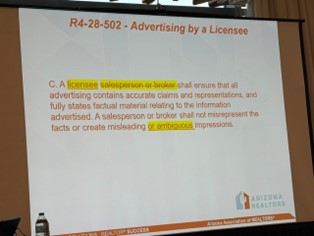
At the center of nearly every violation is one simple requirement:
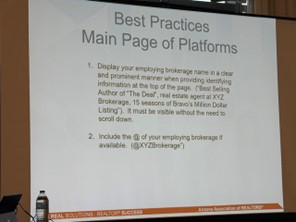
Every advertisement must clearly and prominently display your employing broker’s name.
No exceptions. No shortcuts.
Key points:
The biggest disconnect right now is between how agents use social media and how ADRE defines advertising.
From the Department’s perspective, if someone can identify you as a REALTOR®, your content is likely advertising.
That includes:
In practical terms, the line between “personal” and “professional” content has largely disappeared.
Another major enforcement focus is visibility.
For online and electronic media, required disclosures must be:
If a user has to click, expand, or scroll to find your brokerage name, you may already be out of compliance.
There is some good news.
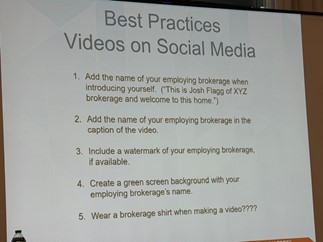
Green confirmed that a video can be compliant if you clearly introduce yourself with your brokerage at the beginning:
“Hi, this is [Name] with [Brokerage], and welcome to this home…”
That alone can satisfy the rule. However, best practice is to layer compliance:
Relying on a single method creates unnecessary risk.
“The Department is not playing games when it comes to advertising compliance.”
Based on the session, these are the most common issues triggering enforcement:
If you advertise a property that is not your listing, you must include a disclosure such as:
“The properties featured are not representative of the licensee’s transaction history and include information of other licensees’ transactions.”
While the rule has evolved, guidance remains somewhat unclear. As a result, best practice is simple:
When in doubt, identify the listing broker and obtain permission.
If you are selling your own property, or the seller is licensed, you must include:
This is a strict requirement and applies to all advertising platforms.
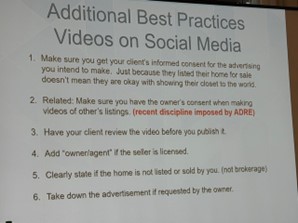
Another area of enforcement is client consent.
Best practices include:
There has already been discipline for agents who filmed properties without proper authorization.
Additionally, a new requirement makes it clear:
If the owner asks you to take down advertising, you must do so.
All advertising must be:
Even subtle implications can create problems. For example, suggesting a listing is yours when it is not may be considered misleading.
“If someone can identify you as a REALTOR®, your content is likely advertising.”
This is one of the most significant shifts in advertising enforcement we have seen in years.
The rules themselves are not new. What has changed is the level of scrutiny and the willingness to enforce them.
As REALTORS®, our professionalism depends on transparency, accuracy, and compliance. This is an opportunity to raise the bar and protect both our clients and our licenses.
I strongly encourage every CAAR member to take this seriously, review your current practices, and work closely with your broker to ensure compliance moving forward.
If you have questions, CAAR is here to help.
Interested in what CAAR does and how you can get involved? Contact us below to talk to our team.