Payson Water Resources Update

By CAAR President Dennis Riccio
Based on recent Arizona case law and statutory developments

Arizona law limits local bans on short-term rentals, but that does not mean a property can legally operate as an Airbnb. CC&Rs and HOA restrictions often control. Here is a practical due diligence framework for REALTORS to avoid misstatements, manage risk, and protect clients. As REALTORS, we are often the first point of guidance on this issue. That makes it critical that we stay within our role, apply a consistent process, and avoid giving conclusions that the documents do not support.
Arizona law prevents cities from banning short-term rentals. It does not give owners the right to violate their CC&Rs.
A buyer calls a week after closing.
“We are ready to list on Airbnb. The HOA sent a violation notice. Minimum lease is 30 days. But we were told short-term rentals are allowed.”
At that moment, the issue is no longer theoretical. It is a potential claim. This is not a rare situation. It is one of the most common preventable risks in today’s transactions.
Arizona operates under two layers of law. Public law governs what cities and counties can regulate. Private law governs what owners can actually do with their property.
Most REALTOR liability lives in the gap between those two.
Arizona is a strong preemption state.
A.R.S. § 9-500.39 and § 11-269.17 prevent cities and counties from banning short-term rentals outright. That protection is often misunderstood.
State law prevents government prohibition. It does not give owners the right to ignore private restrictions.
Local governments still retain authority to regulate operations, including:
Recent legal developments reinforce this structure. Courts continue to reject local attempts to restrict STRs beyond statutory limits while upholding licensing and regulatory frameworks.
A newer nuance involves accessory dwelling units. In certain cases, municipalities may require owner occupancy when an ADU is used for short-term rental purposes, depending on approval dates.
The key takeaway is simple. Arizona law allows the use category. It does not guarantee the use for any specific property.

In most transactions, the controlling document is not the statute. It is the declaration.
Arizona law is clear:
Both statutes tie rental rights and rental time restrictions directly to the recorded declaration.
The practical hierarchy is:
When there is a conflict, the declaration controls.
This leads to several critical realities:
The Arizona Supreme Court addressed this in Kalway v. Calabria Ranch HOA (2022). Amendments must be reasonable and foreseeable based on the original declaration.
The Court of Appeals applied that rule in Gross v. The Shores at Rainbow Lake (2024), invalidating a 30-day minimum lease amendment because it prohibited what was previously allowed.
Even when restrictions exist, enforcement may vary. Lack of past enforcement does not guarantee future compliance or waiver of restrictions.
The takeaway is not that HOA restrictions fail. The takeaway is that enforceability depends on the specific language and history of the declaration. Expect continued litigation around HOA amendments and short-term rental restrictions as Arizona courts continue to apply Kalway.

“Arizona allows Airbnb everywhere”
Arizona limits local bans. It does not override private covenants.
“If zoning allows it, it’s permitted”
Zoning is only one layer. Permits and CC&Rs still apply.
“Minimum lease terms are straightforward”
Only if they are clearly in the declaration and properly adopted.
“MLS says it’s a vacation rental”
MLS remarks are marketing, not legal authority.
These statements often come from experience. They still create risk when relied upon by a buyer. In each of these situations, the outcome turns on documents, not assumptions.
The Amendment Trap
Buyer reviews original CC&Rs with no restriction. HOA adopts a 30-day minimum lease before closing. Enforceability is unclear. Buyer assumes invalid. HOA enforces anyway.
The MLS Trap
Listing advertises “great Airbnb opportunity.” Declaration requires 90-day minimum lease. Buyer relies on listing language.
The Permit Trap
No HOA restriction exists. Buyer fails to obtain required city permit. STR operations are shut down.
Each scenario results from incomplete verification, not bad intent.
Legal Risk and Liability Exposure

Short-term rental eligibility is a material issue because it directly affects how a buyer intends to use the property. In many cases, STR eligibility is tied directly to a buyer’s income expectations. That increases both the materiality of the issue and the potential exposure if the representation is incorrect.
Under A.R.S. § 32-2153, licensees may face discipline for:
R4-28-1101 requires agents to:
At the same time, agents are not expected to provide legal opinions.
This is the critical boundary.
Most claims do not arise because an agent misunderstood the law. They arise because an agent made a definitive statement without verifying the governing documents.
Marketing adds another layer of risk. Advertising a property as “Airbnb allowed” without support in the declaration can be misleading. The issue is not intent. The issue is making a clear statement without verification.
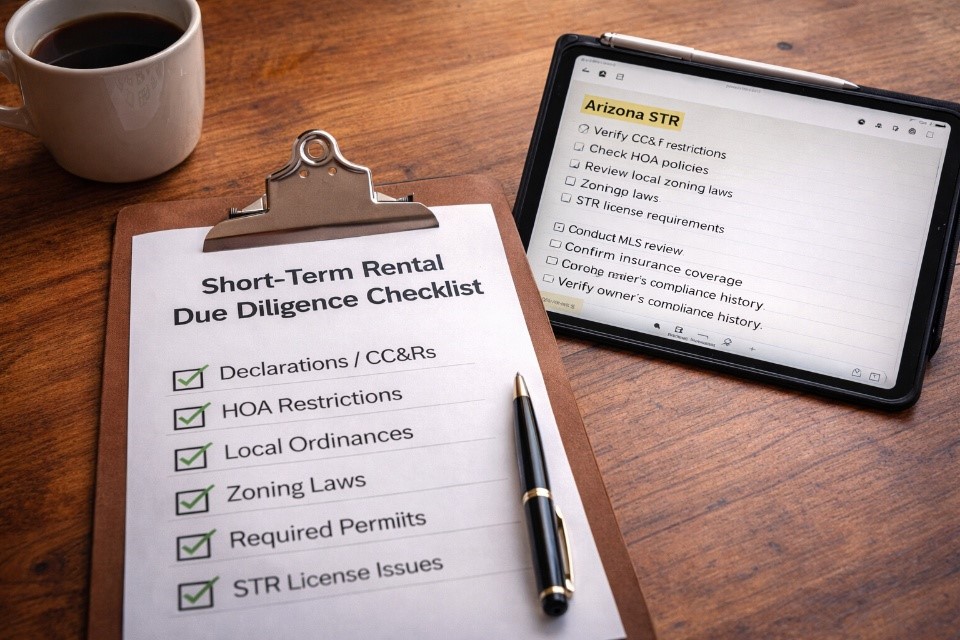
The safest agents follow a repeatable, documentable process:
Brokerages may want to consider standardizing STR disclosures and internal verification procedures. Consistency reduces both agent-level and firm-level risk.
Arizona’s short-term rental laws create a strong foundation. They prevent blanket government bans and support property owner flexibility.
But they do not answer the transaction-level question.
That answer almost always comes from the declaration.
As REALTORS, our role is not to interpret evolving case law in real time. Our role is to apply a disciplined process, communicate clearly, and protect our clients from avoidable risk.
The agents who manage STR risk best are not the ones with the answers. They are the ones with the process. That approach is not just best practice. It is what Arizona law expects.
By Dennis Riccio, CAAR President
Guidance for Arizona REALTORS
This article is provided for general informational purposes only and does not constitute legal advice. Laws, regulations, and governing documents may change or vary by community. REALTORS should not rely on this article as a substitute for legal guidance and should encourage clients to seek independent legal advice when evaluating short-term rental use.
Interested in what CAAR does and how you can get involved? Contact us below to talk to our team.